

For local authority commissioners and frontline social workers, the process of sourcing a residential placement is rarely just about finding an available bed. It is a balancing act of risk management, budgetary oversight, and clinical judgment. When a young person presents with complex placement breakdowns, developmental trauma, or severe emotional and behavioural difficulties (EBD), the instinct can sometimes be to turn to larger, well-established national providers who boast extensive regional frameworks.
However, the trend in residential childcare is shifting. A growing body of evidence, backed by Ofsted inspection outcomes and clinical frameworks, demonstrates that smaller, low-occupancy environments consistently deliver superior, sustained outcomes for young people.
For local authorities looking to secure a long term placement children in West Yorkshire can rely on to break the cycle of instability, the structural design of the home matters just as much as the therapeutic framework. Choosing an intentional 2–3 bed model over a larger 5–6 bed facility is not just an ethical choice; it is a clinical advantage.
The Relational Dynamics of Low Occupancy
At the heart of the argument for a low occupancy children’s home in West Yorkshire is basic human geography. In a large residential home with five, six, or more young people, the environment can inadvertently mirror an institutional setting. The atmosphere is frequently high-stimulus, loud, and unpredictable. For a child who has experienced chronic neglect or abuse, this hyper-arousing environment triggers a continuous state of survival mode.
In contrast, an independent children’s home in West Yorkshire operating on a 2–3 bed footprint functions like a standard family house. The physical environment is quieter, predictable, and visually calmer.
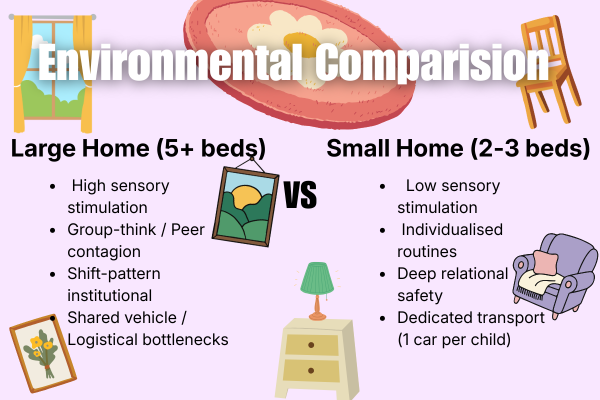
When sensory stimulation drops, the child’s nervous system can begin to co-regulate with the adults around them. In a smaller home, staff are not managing a shifting crowd; they are sitting at a kitchen table with two or three children. This allows for:
- Sustained Co-Regulation: True trauma-informed care requires an adult to be emotionally present to absorb a child’s distress. If a team is pulled in four different directions by multiple crises, their capacity to co-regulate is compromised.
- Reduction of Peer Contagion: In larger homes, negative behaviours can quickly cascade through the peer group. A single incident can escalate into an entire evening of high-risk behavior. Smaller homes radically reduce this contagion effect.
- True Individualised Care: Routines can be tailor-made. If a child needs a quiet, slow evening routine to decompress from school, a 2-bed home can adapt instantly without disrupting the needs of half a dozen other residents.
Attachment Disorder and Relational Trauma
A significant percentage of young people entering residential care live with complex relational trauma. When looking at attachment disorder residential care Yorkshire offers varied environments, but the clinical reality is that attachment security cannot be institutionalised.
Children with attachment difficulties struggle to trust adults. They view parental figures as unsafe, rejecting, or unpredictable. To survive, they use defensive strategies that can manifest as defiance, emotional volatility, or deep withdrawal. Healing these wounds requires a consistent experience of relational safety over an extended period.
In a small children’s home Yorkshire, the structural setup supports attachment work in ways a larger home cannot compete with. Consider the impact on a child’s internal working model:
- Fewer Adult Faces: A smaller home requires a smaller, more consistent core staff team. The child isn’t forced to navigate a rotating carousel of dozens of practitioners across complex shift patterns. They can form deep, secure attachments to a small group of trusted keyworkers.
- Attunement Over Supervision: In a low-occupancy home, staff can notice subtle shifts in a child’s presentation, a change in posture, an unusual silence, a subtle facial expression. This deep attunement allows for early intervention before an emotional crisis manifests as a high-risk behavioral escalation.
- Surviving the Hard Times Together: Because small independent providers can protect their teams from the burnout often found in high-pressure, high-occupancy facilities, staff turnover is lower. This continuity means that when a young person tests the boundaries, the same adults return the next day, proving that they are safe, resilient, and won’t reject them.
How Harmony Instills the Custom Model
This structural and clinical ethos is exactly why Harmony Children’s Services operates with an uncompromising focus on small, intentional care environments. Rather than expanding into institutional-scale facilities, Harmony has purposefully designed its provision around highly specialised, 2–3 bed homes across the region.
Every single home within the portfolio Harmony House, The Hollies, The Chestnuts, and Hebble Cottage is locked into this low-occupancy structure. This is a deliberate operational choice rooted in over 15 years of childcare experience. By keeping our settings strictly small, we ensure that our core principles are never watered down or compromised by commercial scaling pressures.
A practical example of how this small-scale model transforms daily life is our operational policy on logistics: every home maintains a ratio of one dedicated car per child.
In a standard five-bed home, sharing one or two vehicles creates immediate logistical bottlenecks. Simple, therapeutic childhood milestones being picked up on time from an after-school club, attending a family contact visit without a group of other children in the back, or travelling to a specific therapeutic appointment become bureaucratic headaches. At Harmony, our transport ratio ensures that no child is isolated or made to feel like part of a corporate transit operation. It allows our young people to access local mainstream schools, specialised educational provisions, and community activities fluidly, preserving a normal, dignified childhood.
Financial and Operational Advantages for Commissioners
From a commissioning perspective, the initial unit cost of a low-occupancy bed can sometimes look higher on a spreadsheet than a bed in a larger, institutional home. However, looking at the long-term cost-benefit analysis reveals that a therapeutic children’s home in West Yorkshire with a small bed footprint yields substantial financial advantages over the lifecycle of a care plan.
1. Drastic Reduction in Placement Breakdowns
Placement instability is one of the most significant drivers of escalating costs for local authority children’s services. Every time a placement breaks down in a crisis, the child suffers further trauma, and the emergency cost of sourcing an immediate alternative spirals. By building a stable environment from day one, low-occupancy homes prevent the emergency interventions that drain local budgets.
2. Lower Reliance on High-Cost Solitary Provisions
When a child struggles in a large 5-bed home, the behaviors often escalate to the point where they require a “solo” placement often costing tens of thousands of pounds per week. A 2-bed or 3-bed home provides the necessary relational distance and safety to manage complex risks without needing to step up to a solitary, highly restrictive setting.
3. Accelerated Progress Toward Step-Down Outcomes
Because therapeutic intervention is highly concentrated in a small home, young people often achieve stability faster. This accelerates their readiness to step down into foster care or semi-independent living provisions, resulting in net long-term savings for the placing authority.
Regulatory and Sector Excellence
When evaluating an independent children’s home West Yorkshire has to offer, checking sector credentials and regulatory alignment is vital. Harmony is a proud ICHA member children’s home Yorkshire, aligning our operations directly with the Independent Children’s Homes Association standards of excellence. This membership ensures our clinical frameworks, management support, and safeguarding protocols sit at the absolute cutting edge of the residential childcare sector.
Our small-home model is consistently vindicated by regulatory feedback. Ofsted inspections across our West Yorkshire provisions emphasize that children make exceptional progress because they receive highly individualized care from a stable, nurturing, and deeply dedicated staff team. Our reports reflect homes where children experience authentic routines, feel genuinely safe, and build the resilience required to look toward a positive future.
Choosing a Strategic Partner for West Yorkshire Placements
The decision of where to place a child with complex needs should move away from finding a bed space and focus on matching a child to an environment built for recovery.
Larger residential properties will always find a place within the wider care sector, but for children with severe developmental trauma, placement disruption histories, and complex EBD, low-occupancy environments are the gold standard.
By prioritising homes like Harmony House, The Hollies, The Chestnuts, and Hebble Cottage, local authorities invest in a model that prioritises the depth of relationship over the scale of numbers. It is an approach that values a child’s dignity, protects the longevity of the placement, and delivers the long-term outcomes that social care teams strive to achieve.
Make a Placement Enquiry For a Children’s home in West Yorkshire
If you are a local authority commissioner or a senior social worker seeking a stable, therapeutic, low-occupancy environment for a child in West Yorkshire, find out more about our current vacancies and safe matching criteria.
Please take a few moments to fill out our secure placement enquiry form, or reach out directly on 07702 050 890 to discuss our statements of purpose and how we can support your care plan.